


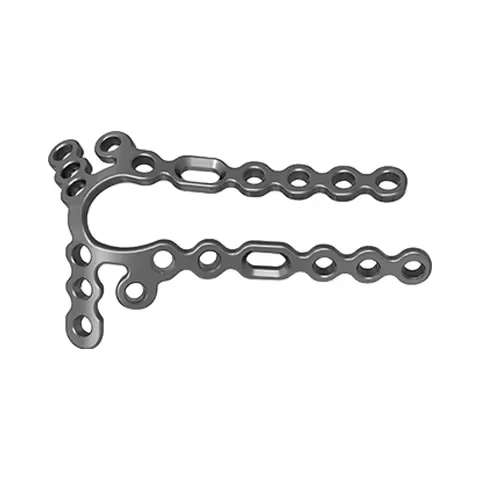
Product Overview
The Locking Plate System is an advanced orthopedic internal fixation implant designed to treat complex bone fractures. By creating a fixed-angle construct between the locking screws and the plate, this system provides significantly higher biomechanical stability compared to conventional plating systems.
Unlike traditional compression plates, locking plates do not rely on plate-to-bone compression to achieve stability. This crucial mechanism helps preserve the periosteal blood supply, minimizes soft tissue irritation, and accelerates the bone healing process.
Technical Specifications
|
Parameter / Specification |
Details |
|
Product Name |
Anatomical Locking Compression Plate System |
|
Material Composition |
Titanium Alloy (Ti-6Al-4V ELI) / Stainless Steel (316LVM) |
|
Surface Treatment |
Type II Anodized (for Titanium) / Electro-polished |
|
Delivery Condition |
Non-Sterile (Standard) / Sterile Packaging Available |
|
Color Coding |
Natural Titanium / Customized Color Anodization |
|
Application Area |
Internal Fixation for Trauma and Orthopedics |
|
Matching Components |
Self-tapping Locking Screws, Cortex Screws |
|
Custom Services |
Fully Available (Custom dimensions, branding, and packaging) |
|
Shelf Life |
5 Years (For sterile packed items) |
Targeted Clinical Applications
High-Energy Trauma
Comminuted, open, and closed fractures of long bones.
Anatomical Alignment
Diaphyseal, metaphyseal, and epiphyseal reconstruction.
Specialized Plating
Complex periarticular and intra-articular fractures requiring rigid support.
Geriatric Orthopedics
Fractures complicated by osteoporotic bone or compromised bone density.
Corrective Surgery
Nonunion reconstruction, malunion correction, and corrective osteotomy.
Biomechanical Features & Material Advantages
Fixed-Angle Stability: Locking screws thread securely into the plate holes, creating a rigid construct that prevents screw back-out, reduces the risk of implant loosening, and ensures structural integrity under physiological loads.
Anatomically Contoured Engineering: Plates are pre-shaped to match human skeletal anatomy. This reduces the need for intraoperative bending, shortens surgery time, and minimizes soft tissue irritation.
Minimally Invasive Friendly: The low-profile design and rounded plate ends are highly compatible with MIPO (Minimally Invasive Plate Osteosynthesis) techniques, significantly reducing patient soft tissue trauma and preserving local blood circulation.
Premium Medical Titanium Alloy (Ti-6Al-4V ELI): This material option provides the highest level of tissue acceptance, minimizing rejection risks. It features an outstanding strength-to-weight ratio for patient comfort, superior corrosion resistance via a stable oxide layer, and generates reduced artifacts under MRI and CT scanning.
Medical Stainless Steel (316LVM): This material option provides high yield strength and fatigue resistance for heavy load-bearing applications. It offers a highly competitive cost structure for mass distribution, excellent machinability for precise thread execution, and decades of proven clinical performance.
Advanced Manufacturing Process
Our production facility utilizes state-of-the-art technology to transform raw medical-grade metals into high-precision implants:
Precision CNC Machining: Multi-axis CNC Swiss lathes and milling machines cut, drill, and thread each plate from solid bars, ensuring micron-level tolerance control.
Anatomical Surface Contouring: Automated and manual polishing processes eliminate sharp edges, burrs, and machining marks to prevent post-operative soft tissue friction.
Advanced Surface Treatment: Titanium plates undergo Type II Anodization to enhance fatigue life and prevent galling. Stainless steel plates are electro-polished to achieve an ultra-smooth, passive, corrosion-resistant surface.
Ultrasonic Cleaning: Implants pass through multi-stage ultrasonic cleaning lines using purified water to eliminate all microscopic manufacturing residues.
Rigorous Quality Control & Compliance
Quality control is integrated into every step of our manufacturing pipeline to ensure absolute patient safety and international regulatory alignment:
Certified Facilities: All production lines operate strictly under the ISO 13485 medical device quality management standard.
Raw Material Verification: Every batch of Titanium and Stainless Steel is verified via chemical analysis and mechanical testing, accompanied by original Mill Test Certificates.
In-Process and Final Inspection: We perform 100% dimensional inspection utilizing optical comparators, coordinate measuring machines (CMM), and digital thread gauges to guarantee flawless screw-to-plate interlocking.
Full Lot Traceability: A comprehensive tracking system links every finished product back to its specific raw material heat number, machining batch, and inspection log.
Contract Manufacturing Services (OEM & ODM)
We support global orthopedic brands and medical device suppliers with scalable manufacturing solutions:
Private Labeling: High-precision laser marking for logos, part numbers, and unique batch tracking codes.
Custom Implant Development: Precision manufacturing based on client 2D/3D technical drawings or physical samples.
Packaging Solutions: Individual sterile blister packaging or bulk non-sterile protective packaging options.
Regulatory Support: Provision of raw material certificates, dimension inspection reports, and technical documentation required for international registration.
FAQ
Q: What clinical indications are your locking plates designed for?
A: Our locking plates are primarily indicated for the fixation of fractures, nonunions, malunions, and osteotomies of various bones, particularly in osteoporotic bone or complex comminuted fractures where traditional plating systems may fail.
Q: What international quality certifications do your manufacturing facilities hold?
A: Our production facilities are certified under the ISO 13485 quality management system for medical devices. We strictly follow international standards for manufacturing, cleaning, and inspection to ensure all products meet global market expectations.
Q: Can you manufacture custom bone plates based on our specific technical drawings?
A: Yes. We offer comprehensive OEM and ODM contract manufacturing services. You can provide your 2D/3D technical drawings, and our engineering team will evaluate the manufacturability and provide a prototyping plan.
Q: Do you provide the regulatory technical documentation required for registration?
A: Yes. We assist our distribution partners by providing necessary technical files, including material test certificates, biocompatibility data, manufacturing flow charts, and dimension inspection reports to facilitate your local registration process.
Q: Are the locking plates shipped sterile or non-sterile?
A: Our standard export configuration is non-sterile, packed in clean protective bags, allowing distributors or hospitals to sterilize them via autoclaving before surgery. However, customized sterile blister packaging can be arranged upon project agreement.
Q: What is your standard production lead time for bulk orders?
A: Lead times vary depending on the product type, quantity, and customization requirements. Typically, standard inventory items can be dispatched promptly, while custom manufacturing runs take a specified number of weeks following technical drawing approval.
Hot Tags: locking plates, China locking plates manufacturers, suppliers, factory, Humeral Nail Kit


