


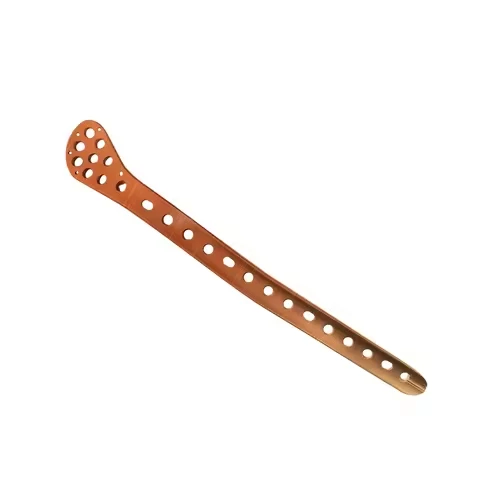
Product Overview
Standard Bone Plates are high-strength internal fixation implants designed to stabilize fractured bones and maintain anatomical alignment during the biological healing process. Engineered to meet rigorous clinical demands, these plates provide rigid mechanical support until complete bone union is achieved.
Our bone plates are fully compatible with standard cortical and cancellous screws, providing versatile fixation options for trauma surgery. Precision-machined to ensure a low-profile fit, they minimize soft tissue interference while delivering long-term structural reliability.
Technical Specifications & Material Profile
|
Parameter |
Medical-Grade Stainless Steel |
Medical-Grade Titanium Alloy |
|
Material Standard |
Stainless Steel 316LVM (ASTM F138) |
Ti-6Al-4V ELI (ASTM F136) |
|
Biocompatibility |
Industry Standard Corrosion Resistance |
Superior Biocompatibility & Osseointegration |
|
Imaging Compatibility |
Standard X-Ray/CT Visibility |
Reduced MRI Artifacts |
|
Surface Finish |
High-Gloss Electro-Polished |
Anodized / Sandblasted / Polished |
|
Hole Configuration |
2 to 16 Holes (Customizable) |
2 to 16 Holes (Customizable) |
|
Thickness Range |
1.5 mm to 5.0 mm |
1.5 mm to 5.0 mm |
Key Product Features
Anatomical Contours: Pre-contoured profiles reduce the need for intraoperative bending and ensure optimal bone-to-plate conformity.
Low-Profile Design: Tapered ends and rounded edges minimize soft tissue irritation and protect adjacent vascular structures.
Versatile Hole Designs: Available in Dynamic Compression Plate (DCP) and Limited Contact DCP (LC-DCP) configurations to optimize axial compression and preserve periosteal blood supply.
Total Traceability: Every single plate features permanent laser etching indicating material lot, part number, and unique production batch.
Surface Engineering
Electropolishing (Stainless Steel): Achieves a high-gloss, ultra-smooth microscopic finish. This process removes surface impurities, enhances the chromium oxide passive layer, and maximizes resistance to pitting and crevice corrosion.
Type II Anodization (Titanium): Creates a controlled, uniform oxide layer that increases surface hardness, reduces friction, and eliminates the risk of galling during screw insertion.
Micro-Topography Control: Every manufacturing batch undergoes strict surface roughness testing to ensure a roughness average of less than or equal to 0.4 micrometers for highly polished surfaces, significantly reducing the potential for micro-abrasions and bacterial colonization.
Indications & Contraindications
Indications
- Standard Bone Plates are indicated for fixation of various single-cortex and dual-cortex fractures, non-unions, and malunions of long and short bones. Specific indications include:
- Diaphyseal and metaphyseal fractures of the humerus, radius, ulna, femur, and tibia.
- Osteotomies for deformity correction or limb lengthening procedures.
- Arthrodesis of select joints requiring rigid compression and stabilization.
Contraindications
These fixation systems should not be used in cases involving:
- Active, overt clinical infections or severe localized inflammation at the operative site.
- Inadequate bone stock or extreme osteopenia that would compromise stable screw purchase.
- Known patient hypersensitivity or documentable allergies to stainless steel, titanium, nickel, or cobalt-chromium alloys.
- Mental or neurological conditions that limit the patient's ability or willingness to follow postoperative weight-bearing restrictions.
System Compatibility
Our standard bone plate portfolio operates as a comprehensive system. They are fully compatible with:
Standard Cortical Screws and Cancellous Screws with matching thread diameters.
Dedicated orthopedic instrumentation sets, including precise Drill Guides, Depth Gauges, Taps, and Screwdrivers.
Advanced Quality Assurance & Mechanical Testing
Operating under strict international quality management systems, every production batch undergoes destructive and non-destructive evaluation to guarantee failure-free clinical performance.
Dimensional Precision: Verified via high-resolution Coordinate Measuring Machines (CMM).
Mechanical Integrity: Evaluated through static tensile tests and multi-million-cycle fatigue testing to ensure optimal yield strength.
Metallurgical Verification: Strict raw material chemical composition and microstructure analysis via spectroscopy.
Packaging, Sterilization & Storage
Packaging Options
- Sterile Pack: Individually sealed in medical-grade Tyvek pouches, sterilized via Ethylene Oxide (EO) or Gamma Irradiation, ready for immediate OR use.
- Non-Sterile Pack: Secured in protective packaging, intended to be cleaned and autoclaved by the hospital facility prior to surgery.
Shelf Life & Storage
- Shelf Life: 5 years for validated sterile packaging.
- Storage Environment: Store in a clean, dry, well-ventilated space at temperatures between 5 degrees and 40 degrees Celsius, with a relative humidity kept below 80 percent.
FAQ
Q: What are the primary clinical reasons to choose titanium bone plates over stainless steel options?
A: Titanium alloy bone plates offer superior biocompatibility, a lower modulus of elasticity that reduces stress shielding, and highly advanced osseointegration properties. Additionally, titanium creates significantly fewer artifacts during postoperative MRI scans, allowing for clearer diagnostic imaging when soft tissue evaluation is necessary. Stainless steel remains an excellent choice for cases demanding higher stiffness and cost-effective structural strength.
Q: How do limited-contact designs protect the periosteal blood supply?
A: Limited-contact designs feature a scalloped or recessed underside that minimizes the surface area touching the bone cortex. Traditional flat plates compress tightly against the bone, which can suffocate the underlying periosteal blood vessels and lead to localized bone necrosis. By reducing this contact area, blood flow to the healing bone is preserved, accelerating the natural biological remodeling process.
Q: Can these bone plates be safely contoured intraoperatively without compromising mechanical strength?
A: Yes, the plates are designed to accommodate reasonable intraoperative contouring to match specific patient anatomy. However, repeated bending or bending at sharp angles must be avoided, as cold working the metal can induce micro-cracks and drastically reduce fatigue life. Specialized bending irons or contouring presses should always be used to achieve smooth curves.
Q: What sterilization parameters must be followed for the non-sterile product variants?
A: Non-sterile plates must undergo a thorough cleaning and decontamination cycle before sterilization. The recommended sterilization method is saturated steam autoclaving using a validated pre-vacuum cycle. Standard parameters include exposure at 132 degrees Celsius for a minimum of 4 minutes, followed by an adequate drying cycle to ensure no moisture remains on the implant or packaging material.
Hot Tags: standard bone plates, China standard bone plates manufacturers, suppliers, factory, Humeral Nail Kit


